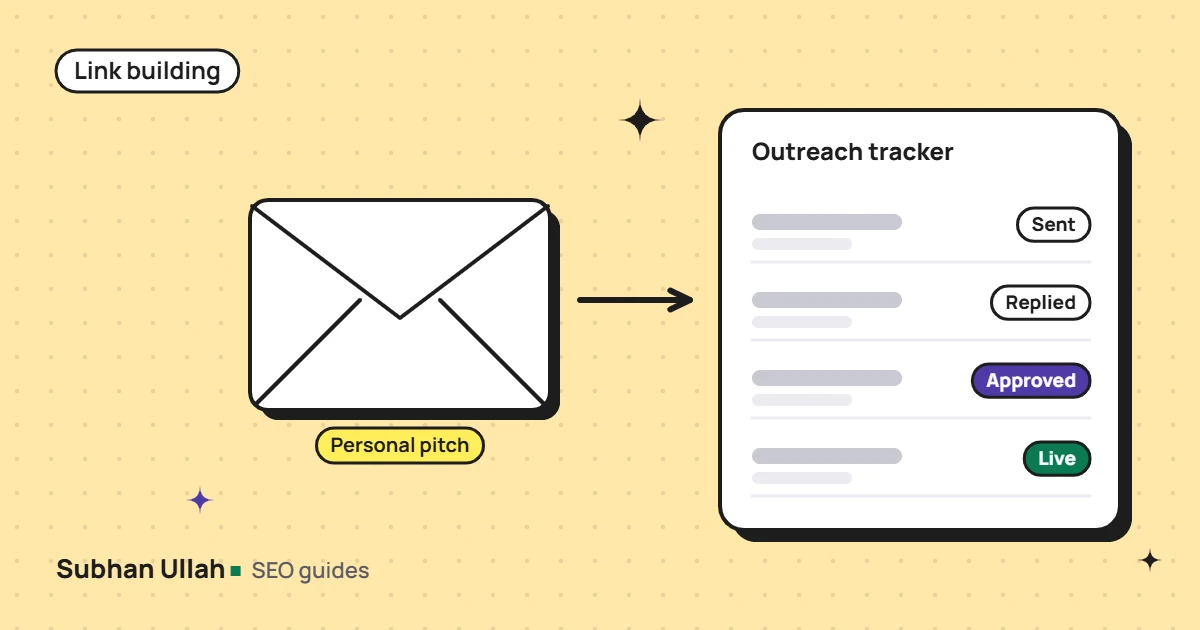
Link building outreach means contacting the people who run relevant sites and asking for a link that is useful to their readers: a guest article, an update to an existing list or guide, or a mention in a resource. It works when three things are right: you contact sites your audience actually reads, you reach the right person through details the site itself publishes, and every pitch is written for that site. It fails when it turns into a volume game. This guide covers the process I use, with numbers from two live programmes.
What a realistic outreach programme looks like
Outreach numbers are smaller than most guides suggest. Two examples from my own work:
| Niche consumer app | B2B SaaS company | |
|---|---|---|
| Prospects | More than 150 community, diaspora, wedding and regional publications researched | 618 pages cited by AI assistants for the category |
| Outreach | A pitch written for each site | Close to 400 personal emails |
| Early results | 6 publications accepted articles in about four weeks; first free guest post live after 17 days | 24 approvals in the first two months; 18 deals in the current quarter, 6 live in the first half of October 2026 |
Neither is a big number, and both are normal for honest outreach. In a small niche the pool of relevant, free publications is short. In a competitive software category, many site owners already get a lot of requests and charge for updates. Plan for that from the start.
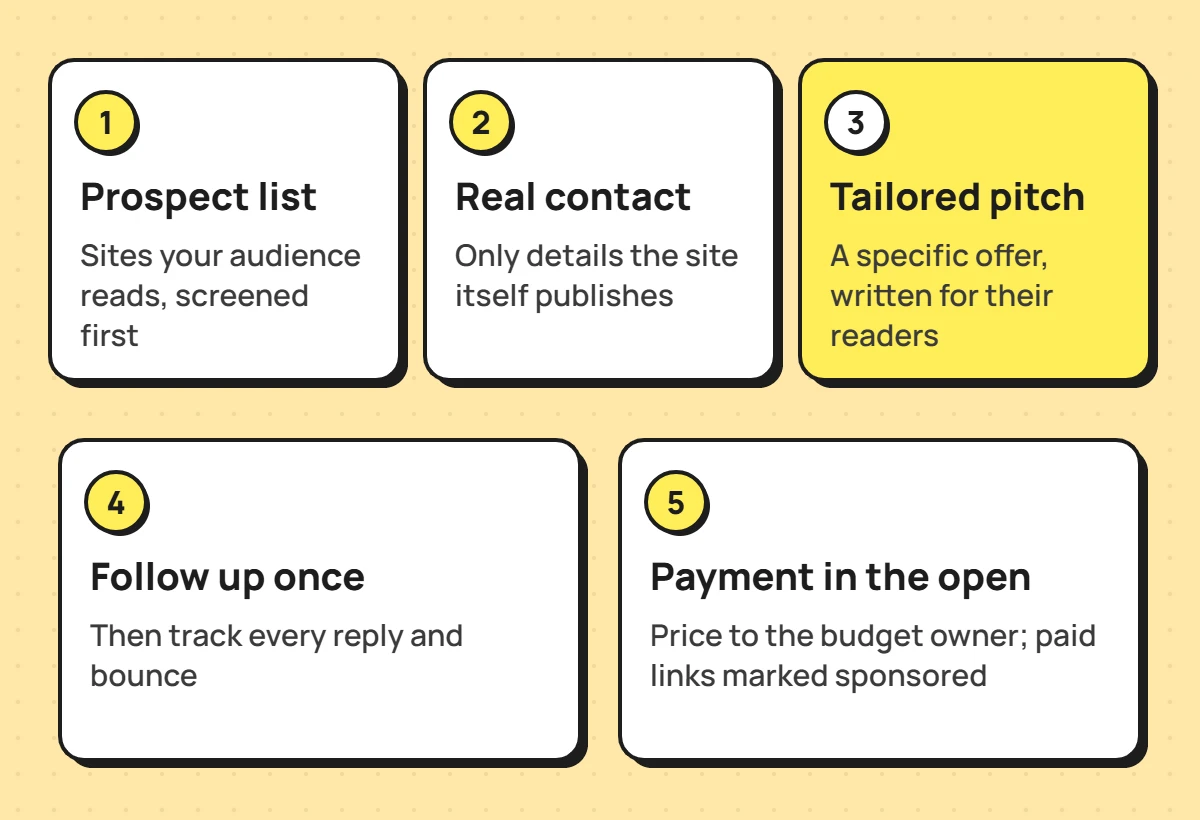
Step 1: Build a prospect list worth contacting
Start with where your audience already reads, not with a list of sites that “accept guest posts”. For the consumer app, that meant community media, diaspora titles, wedding and relationship magazines and regional newsrooms. For the SaaS company, it meant the list articles and comparisons that already shape buying decisions in its category.
Screen every site first
Before a site goes on the list, check:
- Does it have real readers? A site with thousands of linking domains and almost no search traffic is usually selling links.
- Is it still active, with recent posts and a named team or editor?
- Is it part of a network that publishes the same guest posts on dozens of sister sites?
- Have you, or anyone on your team, contacted it before?
Check for past contact
Checking for past contact needs more care than it sounds. On one programme I pitched a publication that a colleague was already in commercial talks with, because I had checked only one tab of the outreach tracker. Now I check every tab and search the whole team inbox for the bare domain before a site goes on the list.
Step 2: Find the right contact on the site itself
Use only contact details the site publishes: its contact, about, team, advertise or write-for-us pages. If the site shows only a form, use the form. Do not guess addresses like editor@ or info@, and do not trust a contact database without checking the live page.
Two lessons learned the hard way
- Follow the site’s own links, never a guessed URL. I once typed a site’s /contact/ address by hand and landed on an empty template page. The real contact page, linked from the footer, was at /contact-us/ and listed an email.
- Read the whole page. Emails often sit in a sidebar, footer or contact widget, which tools that only read the main article text miss completely.
Record where you found each contact, with the page URL. It saves time on follow-ups and makes it easy for anyone else to check.
Step 3: Write a pitch for that one site
A useful pitch is short and specific. It should show you have read the site, and it should make the editor’s job easier:
- A subject line about their content, not about you
- One line on why you are writing to them, naming a real article or section
- The offer: two or three article ideas that fit their audience, or the exact update to an existing page
- Proof you can deliver: a relevant sample, or a line on who you are
- No assumptions you have not checked, such as claiming they accept guest posts when the site does not say so
Writing the guest article
For guest articles, follow the publication’s own guidelines and write for its readers, not for your target keyword. For the consumer app, that meant separate articles for Indian, Australian and UK publications, each written for that audience. Google’s spam policies list links with optimised anchor text in guest posts as link spam, so let the anchor describe the page naturally, or use your brand name.
Step 4: Follow up once, then track everything
Send one polite follow-up after about a week. A sequence of reminders rarely changes the answer and makes your next pitch to that site harder.
Keep one tracker
Keep one tracker for the whole programme, with a row per site: the contact and where you found it, the date of each email, the status, any price or terms, the live URL and the link attribute. Check your inbox for bounces after every batch. A listed address can still be dead: in one batch, two addresses taken straight from the sites’ contact pages bounced as non-existent. A row whose only email bounced should not stay marked as “sent”.
Step 5: Handle payment requests openly
Some sites will ask for a fee. Decide your rules before you start:
- Pass every price and its terms to whoever owns the budget, and let them decide
- If you pay, the link should be marked rel=”sponsored”. Google’s guidance on qualifying outbound links says paid placements should carry that value
- Avoid link swaps as a habit; Google treats excessive link exchanges as link spam
For the consumer app, I turned down paid do-follow links and took properly labelled sponsored terms instead. For the SaaS company, every paid placement was approved by the client’s team first.
How to measure link building outreach
Count what matters, in this order:
- Placements live on relevant sites, each checked by hand
- Approvals and accepted articles still waiting to publish
- Positive replies as a share of pitches sent
- Cost per placement, where money changed hands
- Later: referral traffic and rankings for the pages you linked to
Be patient with the last one. In the consumer app programme, several accepted articles were still waiting to be published at the time of writing, and it was too early to report traffic.
If you want this run for you, my link building service follows this process from research to placement. The marriage app outreach case study shows the niche programme in detail. If your buyers ask AI assistants for recommendations, the same outreach applies to the pages those assistants cite; see how to get your brand mentioned in ChatGPT.
Frequently asked questions
What is a good response rate for link building outreach?
It varies a lot by niche and by how many requests the sites already get. In the SaaS programme, about 400 personal emails led to 24 approvals in the first two months. Judge your own rate against your niche, and improve the targeting before you increase the volume.
Is guest posting still worth it?
Yes, when the publication has real readers in your audience and the article is written for them. Mass guest posting on sites that exist to sell links is not worth it, and links with optimised anchor text in guest posts are named in Google’s spam policies.
Should I use outreach automation tools?
Tools help with tracking and scheduling. Use them for that. The research, the contact checks and the pitch itself should still be done site by site, because that is what gets replies.