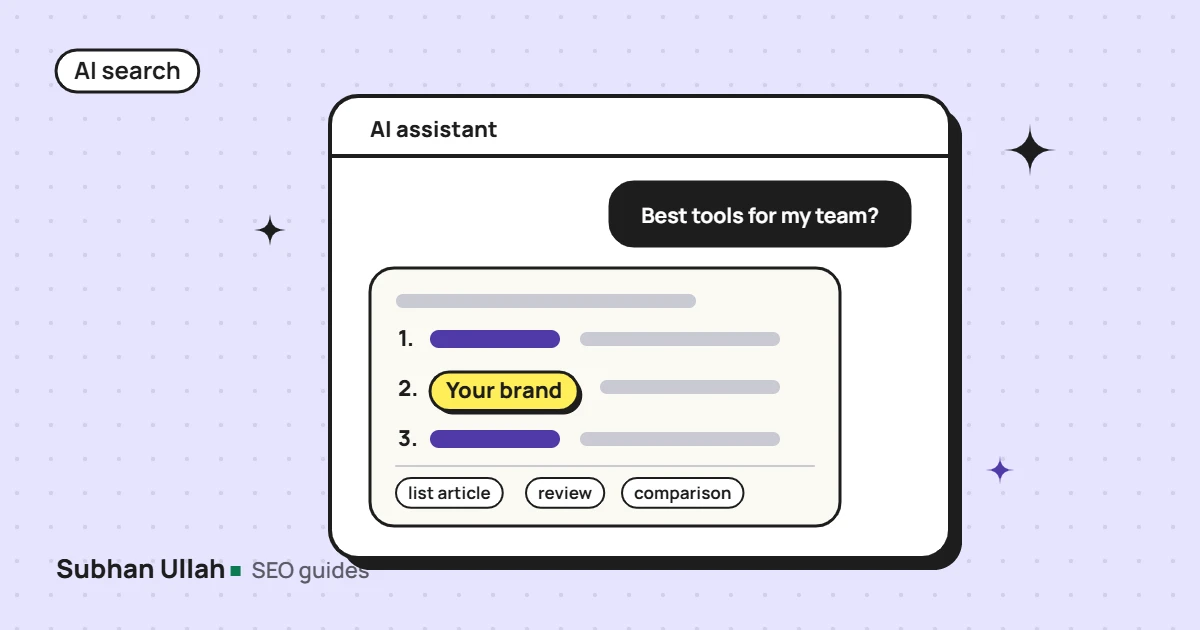
There is no ranking in ChatGPT that you can submit to or pay for. When someone asks it which tools or providers to use, the answer comes from what the model learned in training and, when it searches the web, from the pages it finds and cites. So getting your brand mentioned comes down to four things: let ChatGPT’s search crawler reach your site, get accurately listed on the pages it draws on for your category, make your own pages easy to quote, and keep checking, because the answers change. Nobody can guarantee a mention. You can make one much more likely.
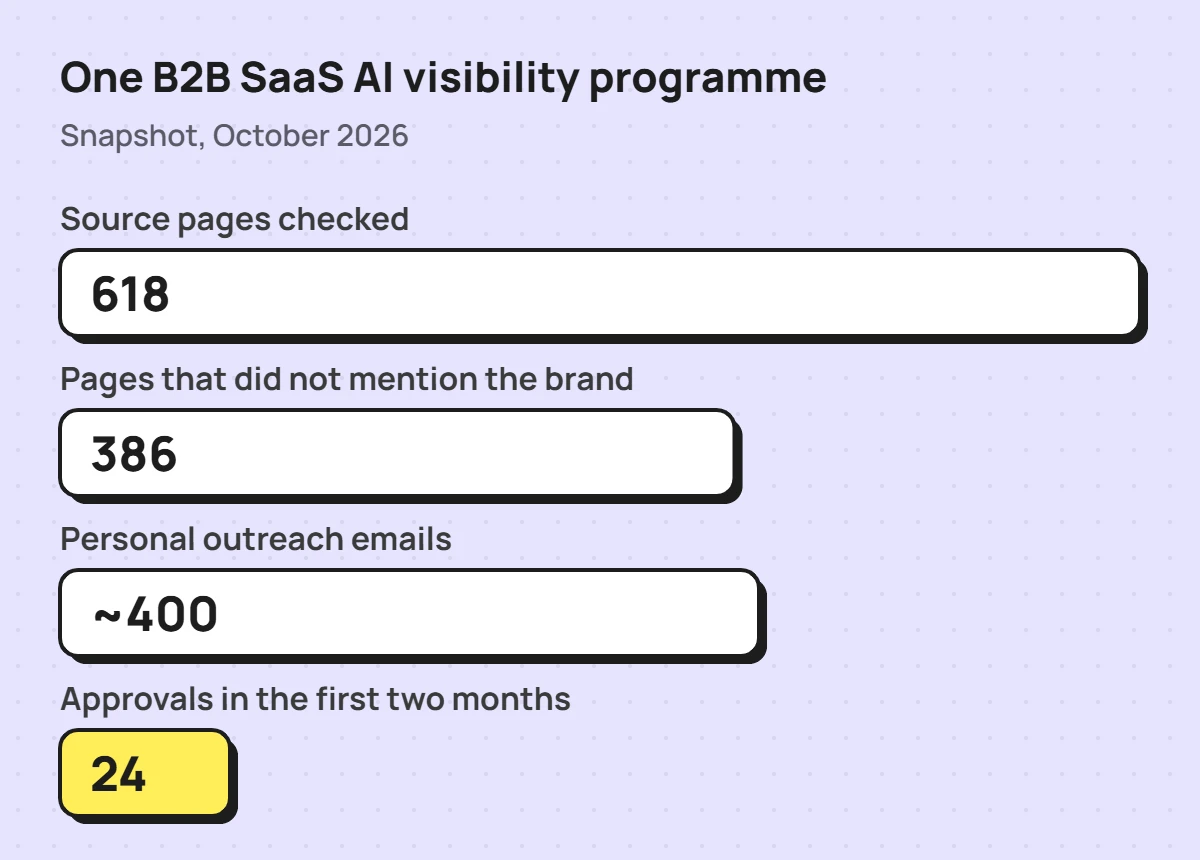
This guide is based on an AI visibility programme I run for a B2B SaaS company, where I worked through 618 of the pages AI assistants cite for its category, one by one.
How ChatGPT decides which brands to mention
Ask ChatGPT for “the best tools for X” and it usually does one of two things. It answers from what the model already knows, which is shaped by training data collected in the past. Or it searches the web and summarises the pages it finds, often with links to them. For buying questions in a busy category, those pages are mostly list articles, comparisons, reviews and forum threads written by other people.
You cannot edit training data, but you can influence the second route. If the pages ChatGPT reads for your category mention you accurately, you have a chance of being named. If they do not, you almost certainly will not be.
Step 1: Make sure ChatGPT can reach your site
OpenAI uses separate crawlers for separate jobs. According to OpenAI’s crawler documentation, OAI-SearchBot is used for ChatGPT’s search features, and sites that block it will not appear in ChatGPT search answers. GPTBot collects content that may be used to train models. The two settings are independent, so you can block training and still allow search.
- Check robots.txt does not disallow OAI-SearchBot, either by name or through a blanket rule
- Check your firewall or CDN is not blocking it as an unknown bot
- Allow about a day for robots.txt changes to take effect; OpenAI says around 24 hours
This is the cheapest fix in the whole process, and the one most often missed when a security plugin blocks every crawler it does not recognise.
Step 2: Find the questions buyers ask and the pages behind the answers
Write down the questions a buyer would type at the point of choosing: “best [category] tools”, “[competitor] alternatives”, “[category] for small teams”. Ask them in ChatGPT with search on, and record every page it cites. Repeat over a few days and in fresh chats, because the answers and their sources vary.
You end up with a list of source pages. The SaaS company already had one for its category, and I worked through 618 pages from it. The list itself is valuable: it tells you exactly where your category’s answers come from, which is a much shorter list than “the whole internet”.
Step 3: Check each source page for a mention
Open every page and note whether it mentions you, how accurately, and where. This is slow, and it is where most of the value is. Of the 618 pages I checked, 386 did not mention the client at all and 65 did. Those 386 pages were the whole opportunity: places that already influence AI answers for the category, where the brand was simply missing.
Record the page’s status too. Some source pages turn out to be broken, out of date or not relevant to your product, and there is no point chasing those.
Step 4: Ask for specific, accurate updates
Then contact the people who run those pages. Generic “please add us” emails get ignored. A request that works usually has:
- The exact page and the section where you would fit
- A short, factual description the editor can use as it is, with no superlatives
- Why it helps their readers: a use case or gap the list does not cover yet
- The right person, taken from the contact or editorial details the site actually publishes
What the response rate looked like
I sent close to 400 personal emails for the SaaS programme. In the first two months, 24 site owners approved an update. By October 2026 there were 18 deals in the current quarter, and 6 of them went live between 1 and 15 October. That is a low response rate by any standard, and it is normal for this kind of work. The pages that matter most are often the ones whose owners get the most requests.
When a site asks for payment
Many sites in competitive software categories only update for a fee. Decide your rules before you start, not deal by deal. In the SaaS programme, every paid placement was approved by the client’s team before it went ahead. If a paid update includes a link, Google’s spam policies treat buying links for ranking as link spam, and say such links should carry rel=”sponsored” or rel=”nofollow”. Ask for that, and keep the description factual so the page stays useful to its readers.
Step 5: Make your own pages easy to quote
Third-party pages carry a lot of weight for “best of” questions, but your own site still has to answer the basics clearly, because that is what an assistant finds when it checks a claim or answers a question about you directly.
- An About page that states plainly what you do, for whom, and where
- Product or service pages that open with a direct one or two sentence answer to “what is this and who is it for”
- Honest comparison pages with a table, rather than claims that you win on everything
- The same short description of your brand on your site, social profiles, directories and review sites
Step 6: Track every page and keep checking
Keep one tracker with a row per source page: whether it mentions you, who you contacted and when, the status, any price, and the outcome. It stops two people pitching the same site and shows what is live, pending or declined. Then re-run your buyer questions every month. AI answers and the pages behind them change often, so this works as an ongoing programme, not a one-off project.
What not to do
- Do not publish dozens of “best tools” lists on your own site that rank you first. Readers and editors see through them.
- Do not post fake reviews or forum comments about your own brand.
- Do not buy links that are not marked as sponsored.
- Do not trust anyone who guarantees a ChatGPT mention. Nobody controls what it cites.
If you want this done for your brand, my AI SEO and GEO services cover the full process, from mapping the source pages to outreach and re-checks. The B2B SaaS AI search visibility case study shows the programme behind the numbers above, and link building explains how I handle placements. For how this fits with the rest of SEO, read GEO vs SEO.
Frequently asked questions
How long does it take to get mentioned in ChatGPT?
Expect months, not weeks. Outreach replies are slow, updates take time to go live, and the pages then have to be crawled again before they can show up in answers. In the SaaS programme, the first approvals came within two months.
Does ranking well in Google help with ChatGPT?
Usually, yes. The list articles and comparisons that rank well for a buying question are often the same pages AI assistants read, and a site that is easy to crawl and clearly written is easier for any system to use. It is not a direct switch, though, so check ChatGPT’s sources rather than assuming.
Should I block GPTBot?
That is a separate decision about model training. Blocking GPTBot does not stop OAI-SearchBot, which is the crawler that matters for ChatGPT search answers. Just make sure a blanket rule is not blocking both.