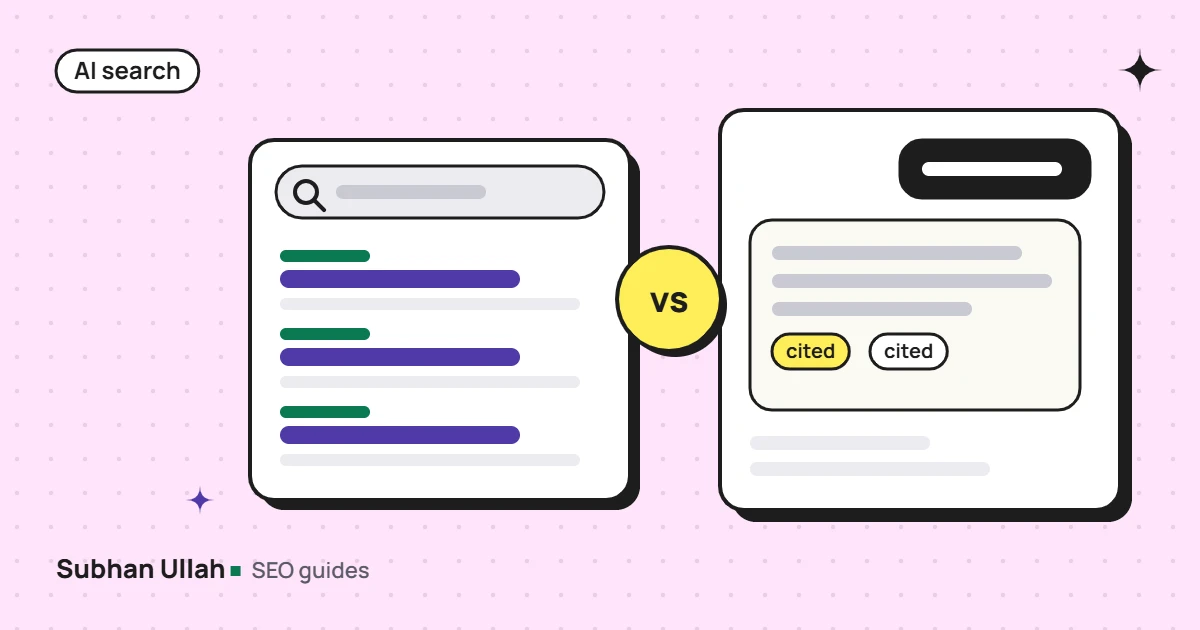
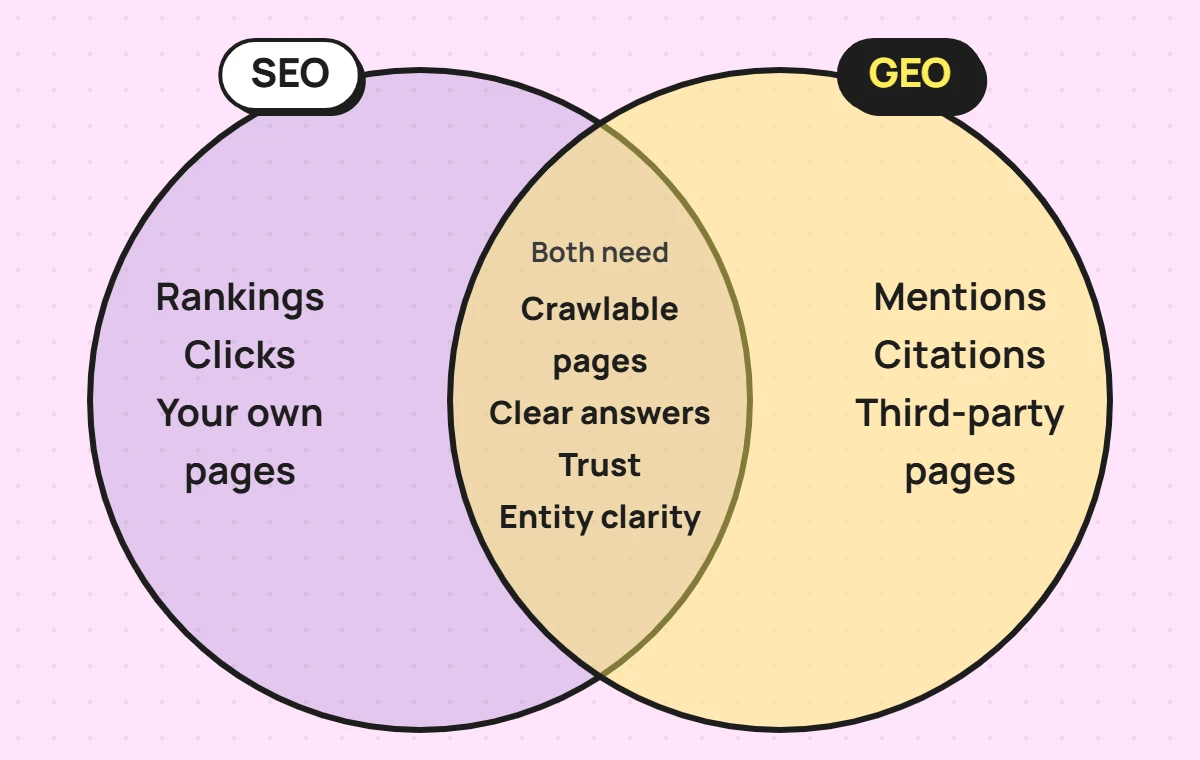
SEO is about getting your pages to rank in search results. GEO, short for generative engine optimization, is about getting your brand included and cited in answers written by AI systems such as ChatGPT, Perplexity and Google’s AI Overviews. Most of the work overlaps: an AI answer can only use pages that are crawlable, clear and trusted, which is what SEO already builds. What changes is the goal (a mention instead of a position), where you need to appear (often on other people’s pages), and how you measure it.
One naming note: “GEO” sometimes means geographic or local targeting. In this guide it means optimisation for AI-generated answers.
Where the term GEO comes from
The term was popularised by a 2023 research paper, GEO: Generative Engine Optimization (Aggarwal and others, first published November 2023). In their test set, adjusting how content was written raised its visibility in generative answers by up to 40%, and the effect varied by subject. That is a research benchmark, not a promise about any live product, but it shows that the way a page is written can change whether an AI system uses it.
GEO vs SEO at a glance
| SEO | GEO | |
|---|---|---|
| Goal | Rank a page for a query | Be named or cited in an AI answer |
| Unit of success | Position and clicks | Mentions, citations and how you are described |
| Where you need to be | Mainly your own pages | Your own pages and the third-party pages AI answers draw on |
| Who crawls you | Googlebot, Bingbot | The same, plus AI crawlers such as OpenAI’s OAI-SearchBot |
| Measurement | Search Console, rankings, analytics | Repeated prompt checks, referral traffic, brand mentions |
| Stability | Rankings move, but gradually | Answers can change between one question and the next |
What does not change
Google’s AI features
Google is direct about its own AI features. Its guidance on AI features says there are no additional requirements to appear in AI Overviews or AI Mode, and no special optimisations are needed. A page has to be indexed and eligible to show in Search with a snippet. In other words, for Google’s AI answers, GEO is SEO.
Other AI assistants
The same foundations carry over to other assistants:
- Access: if a crawler cannot fetch a page, no system can use it
- Clear, helpful content: pages that answer a question directly are easier to rank and easier to quote
- Trust and authority: the pages that rank well for a buying question are often the same pages AI answers read
- Entity clarity: a consistent description of who you are and what you do, on your site and elsewhere
If your technical SEO is broken, GEO will not save it. Fix crawling and indexing first.
What actually changes
1. Other people’s pages matter more
In SEO you mostly compete with your own pages. In AI answers to “best tools for X” questions, the assistant often summarises list articles, comparisons, reviews and forums written by other people. If those pages leave you out, you are left out of the answer, however good your own site is.
This is the biggest practical difference I have seen. For a B2B SaaS company, I checked 618 of the source pages AI assistants rely on for its category. 386 did not mention the brand at all; 65 did. The company’s own site was not the problem. Its absence from the pages that shape the answers was. Closing that gap is outreach and digital PR work, which most SEO plans do not budget for.
2. You are optimising to be quoted, not just found
A page that ranks can still be hard to quote. Passages that make sense on their own are easier for an AI system to lift into an answer: a direct definition, a comparison table, a short list of steps, a specific figure with its source. Writing that way also helps readers who skim, so it rarely costs anything in SEO terms.
3. Crawler access has more moving parts
AI companies run several crawlers with different purposes. OpenAI, for example, documents OAI-SearchBot for ChatGPT search and GPTBot for model training, and the two can be allowed or blocked separately. A blanket rule written to stop AI training can also remove you from AI search answers. Check robots.txt and your firewall with that in mind.
4. Measurement is weaker
SEO has Search Console. For Google’s AI features, Google says that traffic is included in the Performance report under the Web search type, so it is counted but not broken out. For other assistants there is no equivalent console. In practice you measure GEO by asking the same set of buyer questions regularly, recording who is named and which pages are cited, and watching referral traffic and branded searches. Treat it as a trend, not a precise number.
Common GEO mistakes
- Treating GEO as a separate content factory. Mass-producing pages “for AI” usually duplicates what your SEO content should already do.
- Ignoring third-party sources. Rewriting your own pages while the lists that shape the answer still leave you out.
- Blocking the wrong crawler. Stopping AI search access when the intent was only to opt out of training.
- Buying placements without the right link attributes. Google’s spam policies expect paid links to carry rel=”sponsored” or rel=”nofollow”.
- Expecting guarantees. No one controls what an AI system cites.
How to add GEO to an existing SEO plan
- Keep the SEO foundations: crawlable, indexable pages with clear answers.
- Check AI crawler access in robots.txt and at the firewall.
- List the buyer questions in your category and record which pages AI answers cite.
- Check those pages for a mention of your brand, and plan outreach for the gaps.
- Rework your key pages so the important answers stand on their own.
- Re-check the same questions every month.
Steps 3 and 4 are where most of the effort goes. I have written them up in detail, with the outreach numbers, in how to get your brand mentioned in ChatGPT. If you would rather hand it over, see my AI SEO and GEO services or the B2B SaaS case study. And if crawling or indexing is the weak point, start with a technical SEO audit.
Frequently asked questions
Is GEO replacing SEO?
No. AI answers depend on pages that search engines can crawl and trust, so SEO remains the base. GEO adds a focus on mentions and on the third-party pages that AI answers draw from.
Is GEO the same as AEO?
They overlap heavily. AEO (answer engine optimisation) usually refers to direct answers such as featured snippets and voice results, while GEO usually refers to AI-generated answers. The techniques for your own pages are much the same: clear questions, direct answers and accurate facts.
How do I measure GEO results?
Pick a fixed set of buyer questions, ask them on a schedule, and record whether you are named, how you are described and which pages are cited. Alongside that, watch referral traffic from AI assistants and branded search in Search Console.